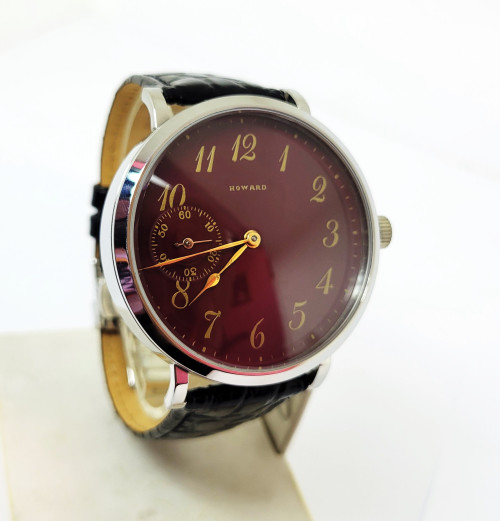
Vintage Men's HOWARD High Grade Winding Movement in Black PVD Watch* Re-Cased
This Men's HOWARD watch is USA-made
Great present for yourself or someone you love, as well as for watch collectors or enthusiasts!
* Stainless steel case in black PVD finish (generic, re-cased)
* Transparent back
* Black color hour Arabic numbers & hands
* Yellow color dial
* Sub-seconds at 9 O'clock
* Watch is in excellent condition
* USA made high grade 17-jewel Howard legendary winding movement circa 1920s with 3 positions adjusted
* Movement has been serviced
* 46 mm case not including crown. Thickness is 14.5 mm. Log-to-log distance is 52.5 mm
* Mineral crystal
* New black color silicon band with orange color stitches
* Watch fits up to 8 inches wrist
* SKU # PA544N
Delivered in a new Gift Watch box. Comes with a one-year store warranty!
History of Howard watch Company:
- Early Clockmaking. In 1842, Edward Howard and David P. Davis formed Howard & Davis in Roxbury, Massachusetts, manufacturing high-grade wall clocks, tower clocks, and precision balances.
- Pioneering Mass Production. In 1850, Howard and Davis partnered with Aaron Lufkin Dennison to form the American Horologue Company (later renamed the Boston Watch Company in 1854). They built a factory in Waltham, Massachusetts, to produce the first successful industrially manufactured watches.
- The 1857 Split. Following the financial panic of 1857, the Boston Watch Company failed. While Royal E. Robbins purchased the Waltham factory (which became the Waltham Watch Company), Howard teamed up with Charles Rice to move the remaining tools and roughly 500 unfinished watch movements back to Roxbury.
- Establishing the Brand. Howard bought out Rice in 1858, officially operating as E. Howard & Co. (and later incorporating as the Howard Watch and Clock Co. in 1861). Unlike competitors who raced to lower prices, Howard focused exclusively on high-grade, luxury, and railroad-standard timepieces.
- Technical Innovations. Working with master horologist George P. Reed, the company introduced major mechanical advancements, including Reed’s divided plate design, the steel safety barrel (which protected the train if a mainspring broke), and early American stem-winding mechanisms.
- Unique Case Sizing. Early original Howard movements were intentionally built to non-standard sizes (designated by letters like N, L, K, J, I, and G) so they could only fit into bespoke cases made specifically for Howard, preventing jewelers from pairing Howard movements with inferior cases.
- Decline of Original Watch Production. Edward Howard retired in 1882. Facing intense competition from lower-cost mass producers like Elgin and Waltham, the company struggled financially. Watch part manufacturing ceased in 1899, though the company continued assembling watches from existing stock and focusing heavily on its dominant tower clock business.
- Acquisition by Keystone. In 1903, the Keystone Watch Case Company purchased the rights to the E. Howard watch name and set up production in the former U.S. Watch Co. factory in Waltham. The original Roxbury firm separated to continue purely as the E. Howard Clock Company. [1, 2, 3]
- Updated Designs. Initially using movements contracted from Waltham (1904–1905), Keystone-Howard soon designed and manufactured its own line of high-grade, standard-sized pocket watches (such as the Series 0, 5, 7, and 10). These remained respected railroad-grade timepieces, though they are distinct from the earlier Roxbury-made watches.
- End of Watchmaking. Hit hard by the Great Depression and the shift toward wristwatches, Keystone discontinued E. Howard watch production in 1930 and sold the trademarks and goodwill to the Hamilton Watch Company.